FIRST TIME IN PARIS: THE GREAT MUST SEES TO DISCOVER ABSOLUTELY
Categories : Parisian life, published on : 5/15/26
There is a particular moment when one arrives in Paris for the first time. Haussmannian perspectives open up, pale stone façades pass by, monuments appear almost as if they had always been waiting there, and very quickly, the city becomes an experience. One does not simply walk through it: one feels it. Through its squares, museums, bridges, lights, cafés, gardens and that unique Parisian way of blending the spectacular with the intimate.
From Hôtel Edouard 7, located on Avenue de l’Opéra, Paris reveals itself with rare ease. On foot, in just a few minutes, the great icons appear: the Opéra Garnier, Place Vendôme, the Louvre, the Tuileries. The rest of the capital naturally unfolds around you, like an invitation to compose your own itinerary.
THE OPÉRA GARNIER
Parisian splendor
Just a few minutes’ walk from Hôtel Edouard 7, the Opéra Garnier is one of the most beautiful manifestos of nineteenth century Paris. Inaugurated in 1875, under the Third Republic, this palace dedicated to music and dance was commissioned by Napoleon III as part of the major works led by Baron Haussmann.
Its architect, Charles Garnier, barely 35 years old when he won the competition, imagined a spectacular building, blending polychrome marble, gilding, mosaics, columns, sculptures and grandiose volumes. Inside, the Grand Staircase, the Subscribers’ Rotunda, the richly decorated foyers and the Italian style auditorium create an almost theatrical setting even before the curtain rises.
The auditorium ceiling, painted in 1964 by Marc Chagall, brings a more modern touch to this world of pageantry. It enters into dialogue with the history of the place by paying tribute to great composers such as Mozart, Wagner, Berlioz and Ravel. The Opéra Garnier also inspired Gaston Leroux for his famous novel The Phantom of the Opera, published in 1910.
Good to know: visits are generally possible during the day, depending on the performance schedule. It is recommended to check opening times before your visit, as certain areas may be closed during rehearsals or events.
Access: 2 minutes on foot from Hôtel Edouard 7
Insider tip: attending a ballet or recital allows you to experience the venue in its true vocation, when architecture, music and light respond to one another.
THE LOUVRE
a journey through the centuries
Around 10 minutes on foot from Hôtel Edouard 7, the Louvre Museum is an obvious choice for a first visit to Paris. Before becoming the largest art museum in the world, the Louvre was a medieval fortress, built from the late twelfth century under Philippe Auguste, then a royal residence, transformed over the centuries by François I, Henri IV, Louis XIII and Louis XIV.
The museum officially opened in 1793, during the French Revolution. Today, it houses collections of exceptional richness, spanning Antiquity, the Renaissance, European schools, Islamic art, sculptures, decorative arts and great history paintings.
Among the most famous works, one cannot fail to mention Leonardo da Vinci’s Mona Lisa, painted in the early sixteenth century, the Venus de Milo, discovered in Greece in 1820, the Winged Victory of Samothrace, a Hellenistic masterpiece from the second century BC, or Liberty Leading the People by Eugène Delacroix, painted in 1830.
But the Louvre is also discovered in its details: painted ceilings, former royal rooms, the Cour Marly, the Apollo Gallery, restored in the nineteenth century and designed as a setting for the Crown Jewels.
Good to know: the museum is closed on Tuesdays. Evening openings allow certain rooms to be visited in a more peaceful atmosphere.
Access: on foot from the hotel, via Avenue de l’Opéra
Insider tip: choose a focused visit rather than trying to see everything. Select one wing, one period or a few masterpieces, then let yourself be carried along.
A good address nearby: Café Marly, beneath the arcades of the Louvre, offers an exceptional view of Ieoh Ming Pei’s pyramid, inaugurated in 1989.

THE TUILERIES GARDEN
a royal promenade
As a natural continuation of the Louvre, the Tuileries Garden is one of the capital’s most beautiful places to breathe. Created in the sixteenth century at the request of Catherine de Medici, then redesigned in 1664 by André Le Nôtre, gardener to Louis XIV, it embodies the art of the French formal garden: perspectives, symmetry, ponds, straight avenues and sculptures.
This garden connects the Louvre to Place de la Concorde, along a majestic line that then continues toward the Champs Élysées, the Arc de Triomphe and, farther away, the Grande Arche of La Défense. This historic perspective, one of the most famous in Paris, gives the walk an almost cinematic dimension.
The Tuileries are also home to several sculptures by Maillol, Rodin, Giacometti and Dubuffet, as well as two major cultural institutions: the Musée de l’Orangerie, where Claude Monet’s large Water Lilies panels are displayed, and the Jeu de Paume, dedicated to contemporary image making.
Access: 12 to 15 minutes on foot from Hôtel Edouard 7.
Insider tip: cross the garden at the end of the day, when the light falls over the ponds and the façades of the Louvre take on a golden hue.
PLACE VENDÔME
the mineral elegance of Paris
Just a few minutes from Hôtel Edouard 7, Place Vendôme reveals a more hushed and precious face of Paris. Designed at the end of the seventeenth century under Louis XIV by architect Jules Hardouin Mansart, it is one of the most perfect examples of French classical urban planning.
At its center, the Vendôme Column, erected from 1806 at the request of Napoleon I, commemorates the Battle of Austerlitz. Inspired by Trajan’s Column in Rome, it is covered with bronze bas reliefs made from cannons taken from the enemy, according to imperial tradition.
Today, the square is associated with high jewelry, watchmaking and the great luxury houses. Cartier, Boucheron, Van Cleef & Arpels, Chaumet and Chanel continue to uphold a Parisian art of living where heritage enters into dialogue with artisanal excellence. Strolling across Place Vendôme also means enjoying the pleasure of admiring exceptional window displays, finding inspiration to delight a loved one, or simply savoring, through the eye, one of the most refined expressions of Parisian luxury.
Access: 7 minutes on foot from Hôtel Edouard 7.

NOTRE DAME DE PARIS
emotion at the heart of the city
Majestic and timeless, the Cathedral of Notre Dame de Paris has watched over the Île de la Cité for more than eight centuries. Its construction began in 1163, under the impetus of Bishop Maurice de Sully, and extended over nearly two hundred years. It became one of the great masterpieces of Gothic architecture, with its flying buttresses, rose windows, towers, gargoyles and monumental balance.
Notre Dame has crossed the history of France. It has witnessed coronations, Te Deums, revolutions and restorations. In 1804, Napoleon I was crowned emperor there in the presence of Pope Pius VII. In 1831, Victor Hugo published Notre Dame de Paris, the novel that powerfully helped revive interest in the cathedral, then in a weakened state. A few years later, architect Eugène Viollet le Duc undertook a major restoration campaign and notably added the famous nineteenth century spire.
After the fire of April 15, 2019, which destroyed the medieval timber frame and caused the spire to collapse, Notre Dame became the symbol of a worldwide emotion. The cathedral reopened to the public in December 2024, after five years of restoration. Its current opening times vary depending on the day, with daytime access and a late opening on Thursdays. It is recommended to check the information before visiting.
Access: around 15 minutes by taxi from the hotel, or by metro and RER toward Saint Michel Notre Dame.
Insider tip: arrive by the banks of the Seine, from Pont Neuf or Pont Saint Louis, to feel the full power of its setting at the heart of Paris.
A good address nearby: Shakespeare and Company, opposite Notre Dame, is a legendary stop for lovers of English language literature.
THE SAINTE CHAPELLE
a jewel of light on the Île de la Cité
Just a few steps from Notre Dame, the Sainte Chapelle is one of the most moving treasures in Paris. Built in the thirteenth century at the request of Louis IX, the future Saint Louis, it was designed to house the relics of the Passion of Christ, including the Crown of Thorns and a fragment of the True Cross. Its construction, completed in less than seven years, was a remarkable achievement for the time.
From the outside, the building seems almost discreet, set within the enclosure of the former royal palace on the Île de la Cité, now integrated into the Palais de Justice. But as soon as one enters the upper chapel, the eye shifts into another dimension. Fifteen monumental stained glass windows, composed of more than a thousand biblical scenes, transform the walls into surfaces of light. Blue, red, gold and violet seem to suspend time.
The Sainte Chapelle embodies the height of Rayonnant Gothic. Here, architecture becomes almost immaterial: stone gives way to stained glass, structure becomes lace, and light becomes narrative.
Good to know: reserving a time slot is strongly recommended, especially with the Paris Museum Pass.
Insider tip: visit the Sainte Chapelle on a sunny day, when the stained glass reveals its full intensity.
THE SEINE
Paris in motion
The Seine is not merely a river: it is the backbone of Paris. It crosses the capital from east to west, connecting some of its greatest monuments in a natural continuity. Its quays, listed as a UNESCO World Heritage Site, offer one of the city’s most beautiful walking routes.
From the riverbanks, Paris reveals itself differently. The Louvre, the Institut de France, Notre Dame, the Conciergerie, the Musée d’Orsay, the Grand Palais, the Eiffel Tower: everything seems to enter into dialogue with the river. The bridges themselves tell a story, from Pont Neuf, the oldest bridge in Paris despite its name, completed in the early seventeenth century under Henri IV, to Pont Alexandre III, inaugurated for the 1900 Exposition Universelle.
A cruise on the Seine makes it possible to grasp the city as a whole, especially during a first stay. It offers a moment of breathing space between visits, with that unique feeling of watching Paris pass by like a living backdrop.
Access: boarding possible near Pont Neuf, Notre Dame or the Eiffel Tower.
Insider tip: choose a departure shortly before sunset, when the light glides over the façades and the monuments begin to illuminate.
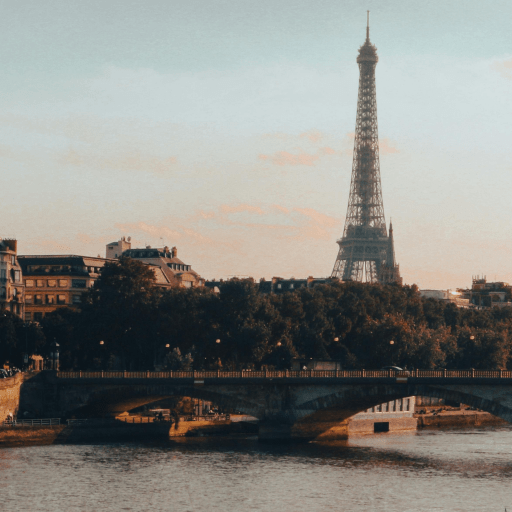
THE EIFFEL TOWER
the universal icon
It is impossible to imagine Paris without the Eiffel Tower. Built by Gustave Eiffel and his teams for the 1889 Exposition Universelle, it was intended to celebrate the centenary of the French Revolution and demonstrate France’s industrial expertise. Originally 300 meters high, it long remained the tallest monument in the world.
When it was built, the tower provoked fierce criticism. Artists and writers, including Guy de Maupassant, Charles Gounod and Alexandre Dumas fils, denounced its metallic aesthetic, considered too daring for Paris. Yet the structure quickly became a symbol. First a technical feat, then a telecommunications antenna, it established itself throughout the twentieth century as the absolute emblem of the capital.
From its platforms, the view embraces the city in all its geometry: the Champ de Mars, the Trocadéro, Les Invalides, Montmartre, the Seine and the great Haussmannian avenues. In the evening, every hour, the tower sparkles for a few minutes, a spectacle that has become inseparable from the Parisian imagination.
Good to know: opening times vary according to the seasons and access conditions. The official website indicates the day’s opening hours and recommends booking in advance.
Access: metro line 6, Bir Hakeim station, or taxi from the hotel in 15 to 20 minutes depending on traffic.
Insider tip: reserve a time slot at the end of the day to see Paris move from golden light to its first illuminations.
A good address nearby: Café de l’Homme, on Place du Trocadéro, offers one of the most beautiful views of the Eiffel Tower.

THE CHAMPS ÉLYSÉES AND THE ARC DE TRIOMPHE
the great Parisian perspective
For a first time in Paris, the Avenue des Champs Élysées remains an essential passage. It extends the historic axis that begins at the Louvre, crosses the Tuileries Garden and Place de la Concorde, then rises toward the Arc de Triomphe. This majestic perspective tells, in itself, several centuries of urban and political history.
Laid out in the seventeenth century by André Le Nôtre, the avenue gradually became one of the most famous promenades in the world. In the nineteenth century, it established itself as a place for strolling, cafés, theaters, shops and national celebrations. Even today, it hosts major public gatherings, the July 14 parade and the finish of the Tour de France.
At the top of the avenue, the Arc de Triomphe dominates Place Charles de Gaulle. Commissioned by Napoleon I in 1806 after the victory at Austerlitz, it was completed in 1836 under Louis Philippe. Its monumental sculptures, notably The Departure of the Volunteers of 1792, better known as La Marseillaise, created by François Rude, celebrate the great military moments of France. Beneath the arch lies the Tomb of the Unknown Soldier, installed in 1921, whose flame is rekindled every evening.
Climbing to the terrace of the Arc de Triomphe allows one to understand the spectacular organization of western Paris: twelve avenues radiate around the square, while the perspective stretches toward La Défense.
Insider tip: favor the late afternoon, when the light descends over the avenue and the façades gradually begin to glow.
A good address nearby: after discovering the Champs Élysées and the Arc de Triomphe, extend the experience just a few minutes away with the aperitivo at Hôtel de Sers, an elegant address on Avenue Pierre 1er de Serbie, or with tea time at Hôtel Vernet, just steps from the Étoile, for a gourmet interlude in a refined Parisian setting.
MONTMARTRE
the bohemian spirit
Perched on the heights of northern Paris, Montmartre offers an atmosphere all its own. Before being integrated into Paris in 1860, this district was an independent village, known for its windmills, vineyards, gypsum quarries and cabarets. At the end of the nineteenth century and the beginning of the twentieth century, it became one of the great centers of Parisian artistic life.
Pablo Picasso set up his studio there at the Bateau Lavoir, where he notably painted Les Demoiselles d’Avignon in 1907. Amedeo Modigliani, Suzanne Valadon, Maurice Utrillo, Henri de Toulouse Lautrec and Vincent van Gogh also frequented the neighborhood. Cafés, dance halls, studios and cabarets, such as the Moulin Rouge, which opened in 1889, helped forge the bohemian legend of Montmartre.
At the top of the hill, the Basilica of the Sacré Cœur dominates Paris. Its construction began in 1875 and was completed in 1914, in a Roman Byzantine style recognizable by its white stone. From the forecourt, the view stretches across the entire capital.
But Montmartre is best discovered by moving away from the busiest routes: Rue de l’Abreuvoir, Place Dalida, the Lapin Agile, the Montmartre vineyard, the Musée de Montmartre or the discreet stairways that reveal another side of the neighborhood.
Insider tip: come in the morning, when the little streets are still quiet, and walk back down toward Pigalle or Saint Georges.
A good address nearby: the Musée de Montmartre and its Renoir gardens, to extend the visit in a more intimate atmosphere.
THE MUSÉE D’ORSAY
the golden age of Impressionism
Housed in the former Orsay railway station, built for the 1900 Exposition Universelle, the Musée d’Orsay is another essential stop for a first visit to Paris. The building itself is worth the detour: a vast luminous nave, a monumental clock, railway volumes transformed into a museum setting.
The museum is dedicated to the arts of the second half of the nineteenth century and the beginning of the twentieth century. It houses one of the most important Impressionist and Post Impressionist collections in the world, with works by Claude Monet, Édouard Manet, Pierre Auguste Renoir, Edgar Degas, Paul Cézanne, Vincent van Gogh, Paul Gauguin and Camille Pissarro.
Here, one discovers a Paris in full transformation: cafés, dancers, railway stations, gardens and scenes of modern leisure. Impressionism, born in the 1870s, appears as a revolution of the gaze, attentive to variations of light, fleeting moments and the new rhythms of urban life.
In 2026, the Musée d’Orsay is notably celebrating Pierre Auguste Renoir through two temporary exhibitions: Renoir the Draftsman, until July 5, 2026, and Renoir and Love. Happy Modernity 1865 1885, until July 19, 2026, a wonderful opportunity to rediscover one of the great masters of Impressionism during a first stay in Paris.
Access: around 10 minutes by taxi from the hotel, or a beautiful walk on foot across the Louvre and the quays.
THE MARAIS AND PLACE DES VOSGES
historic and vibrant Paris
To discover a more intimate Paris, head to the Marais. This district, located between the Hôtel de Ville, Rue de Rivoli and Place de la République, preserves an exceptional heritage of private mansions, old streets, galleries, museums and confidential addresses.
At the heart of the neighborhood, Place des Vosges is one of the most beautiful squares in Paris. Inaugurated in 1612 under the name Place Royale, it was envisioned by Henri IV and became a model of urban elegance with its brick and stone façades, regular arcades and central garden. Victor Hugo lived at number 6 on the square, where his house museum can be found today.
The Marais is also a museum district: the Musée Carnavalet, dedicated to the history of Paris, the Musée Picasso, housed in the Hôtel Salé, and the Maison Européenne de la Photographie. It is an ideal place for a half day of strolling between culture, boutiques, galleries and gourmet pauses.
A good address nearby: Carette, beneath the arcades of Place des Vosges, for an elegant pause facing the garden.
SAINT GERMAIN DES PRÉS
the literary spirit of the Left Bank
On the Left Bank, Saint Germain des Prés embodies another Parisian myth. Around its abbey, whose origins date back to the sixth century, the neighborhood established itself over the centuries as a major intellectual, artistic and literary center.
In the twentieth century, Saint Germain became the district of writers, publishers, philosophers and jazz musicians. Jean Paul Sartre, Simone de Beauvoir, Boris Vian, Juliette Gréco and Jacques Prévert frequented its cafés and cellars. Les Deux Magots, Café de Flore and Brasserie Lipp became institutions, where literature, politics and the art of living crossed paths.
Today, Saint Germain retains this particular elegance: bookshops, galleries, antique dealers, boutiques, private mansions, ancient churches and historic cafés compose a setting that is both lively and deeply rooted in heritage.
Insider tip: continue on to the Luxembourg Garden, one of the most beautiful gardens in Paris, created from 1612 at the request of Marie de Medici.
PARIS
the beginning of a story
Paris never reveals itself entirely in a single visit. Each place, each street, each light opens a new perspective. One comes to see the Eiffel Tower, the Louvre, Notre Dame or the Champs Élysées, and often leaves with the memory of a detail: a façade at sunset, a café glimpsed around a corner, a walk along the quays, a silence inside a chapel, a view from a bridge.
From Hôtel Edouard 7, the city can be discovered naturally. In the morning, a walk toward the Opéra Garnier, the Louvre or the Tuileries. In the afternoon, an immersion in a neighborhood, from Montmartre to Saint Germain des Prés. In the evening, a return to the comfort of the rooms at Hôtel Edouard 7 or a moment at the hotel’s restaurant, to prolong the experience in an elegant and Parisian atmosphere.
Because a first time in Paris is never an ending. It is the beginning of a story.